


Conceived during the fourth edition of the Hands-on Residency, the new body of work by Seongeun Lee unfolds through an exploration of time, transformation, and human existence.
Moving between sculpture and textile as material and conceptual structures, her practice approaches form as a reflection on the fragile and evolving condition of existence. Developed through a series of experiments with rust and oxidation, the works emerged from an investigation into the ways time inscribes itself onto matter, revealing aging not as deterioration but as a continuous process of formation. Structured through variations of standing, suspended, stretched, and partially unfolded columns, the series considers the relationship between individual presence and collective arrangement, where each form carries the traces of its own duration. Through weathered surfaces, muted earthy tones, and tactile textile constructions, Lee’s works resist fixed definitions, instead inhabiting a space of accumulation, transformation, and becoming.
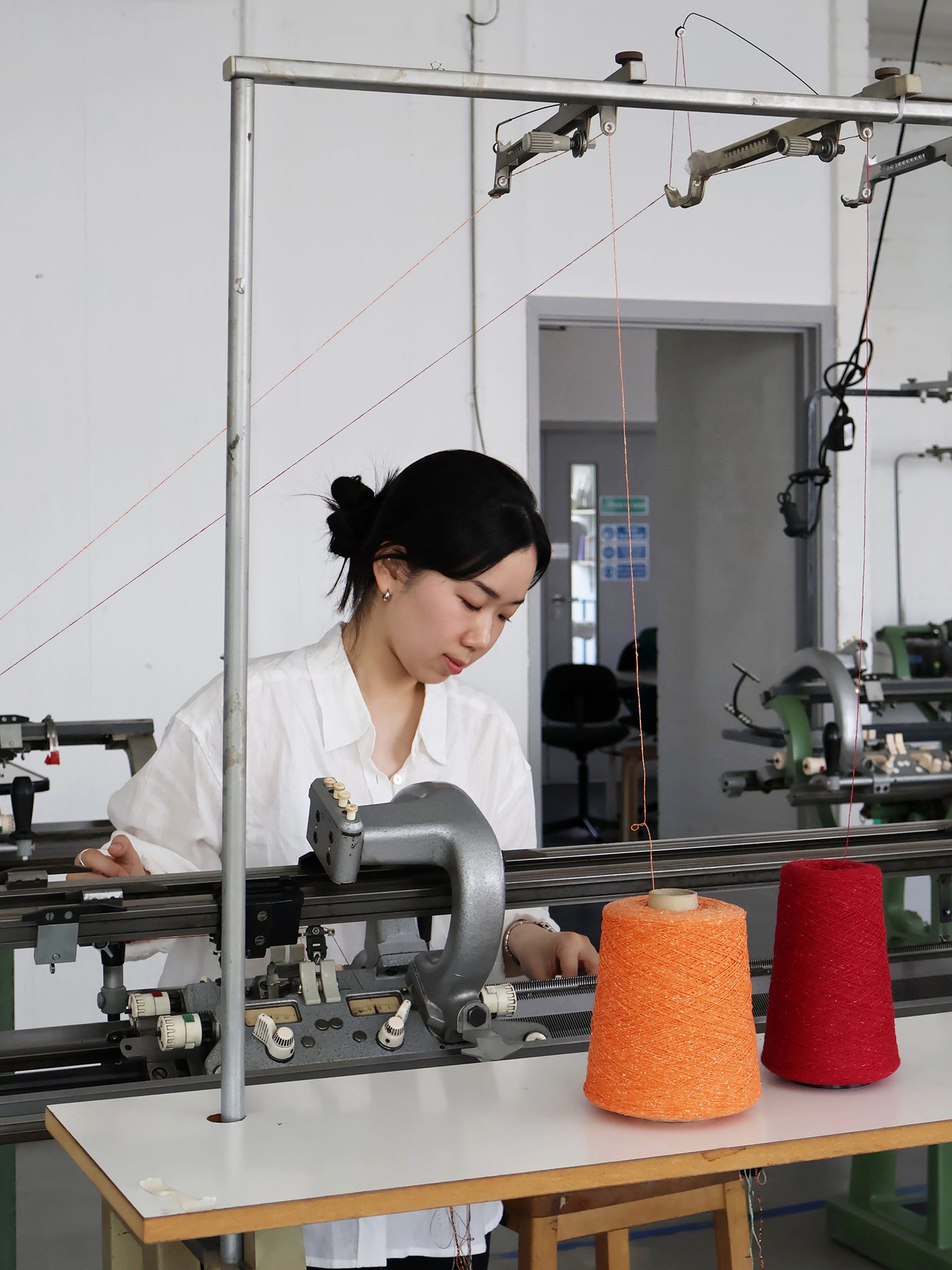
Hands-on: Throughout your practice, the column has functioned as a metaphor for existence, while arrangements speak about relationships. How has introducing the idea of aging transformed this vocabulary? Has it changed what a “column” can represent?
Seongeun Lee: For me, arrangement is a way of understanding human existence. Human beings do not exist independently but are constantly shaped through relationships with others. The column is the smallest unit of these arrangements and has become my own artistic language.
Introducing aging expanded what the column represents. While my earlier work explored how human existence forms relationships, this residency project explores how human existence changes and accumulates through time. In this project, the column becomes a medium that records time. Through rust dyeing, textile absorbs environmental conditions such as humidity, temperature, and air, allowing time itself to become physically embedded in the work.
Hands-on: Rust is often associated with decay and deterioration, yet you describe it as evidence of continual formation. What attracted you to this reversal? How does working with oxidation challenge our cultural understanding of aging as something to resist rather than embrace?
Seongeun Lee: I do not see rust as decay. Rather, it is evidence that iron continues to interact with air, moisture, and time. Rust is not an ending but an ongoing process of formation.
This closely reflects how I think about aging. We often associate aging with loss, but I see it as the accumulation of lived time. Because rust dyeing cannot be completely controlled, every work becomes a unique record of its environment. Like aging itself, I believe these changes should be understood not as decline, but as continuous becoming.
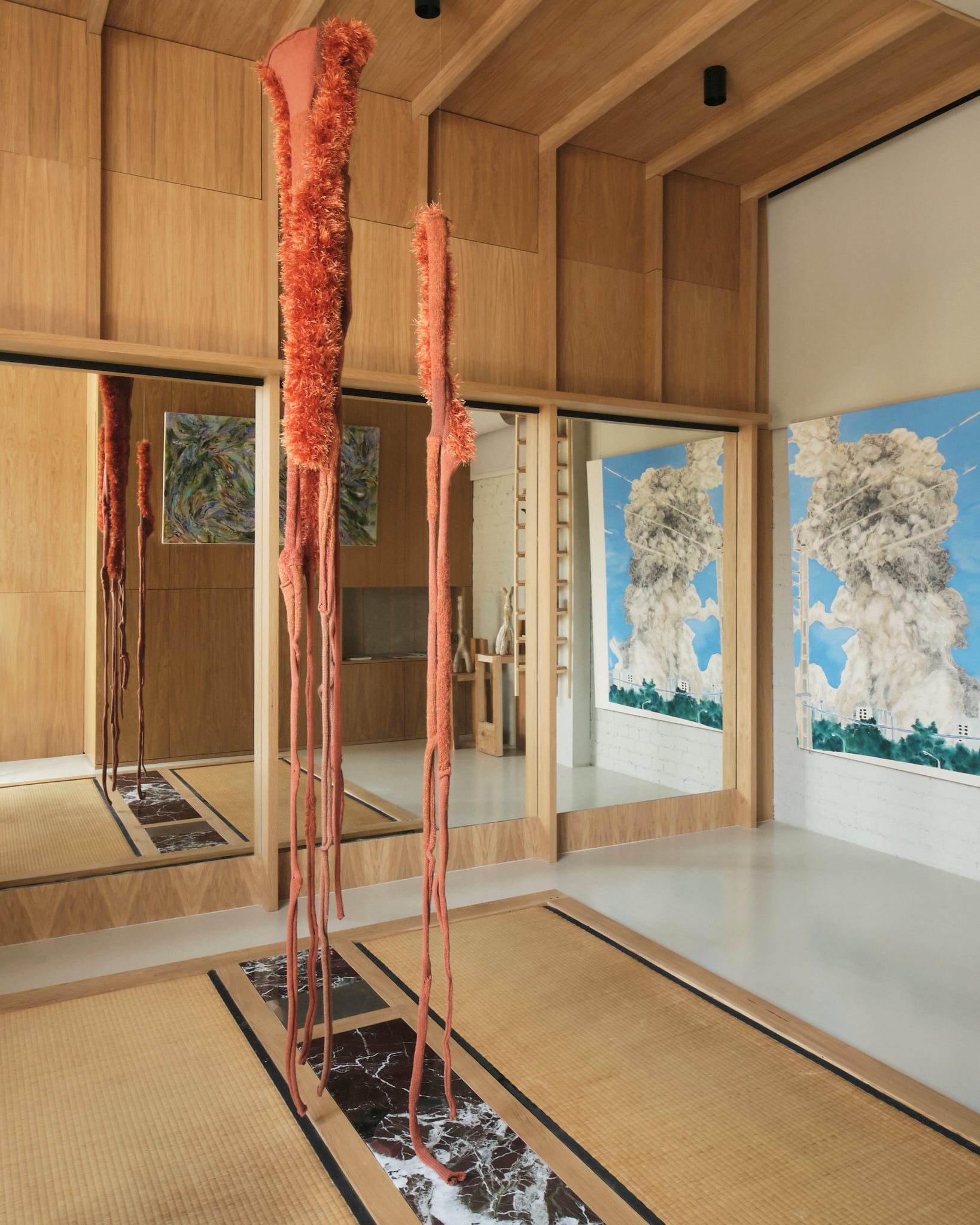
Hands-on: Your textile columns never become literal bodies, yet they evoke posture, vulnerability, endurance, and presence. What possibilities emerge when the human body is suggested rather than represented directly?
Seongeun Lee: I am not interested in representing the human body literally. Instead, I translate its underlying structure into the visual language of the column. In my work, the surface of the column represents skin, while its interior suggests muscle. Skin records time through contact with the environment, while muscle maintains balance and tension beneath the surface.
Recently, I have been exploring the idea of the “muscle of the column.” Textile is particularly suited to this because it stretches, sags, contracts, and responds to gravity. Rather than depicting the body itself, I use textile to visualize the invisible forces that sustain human existence.
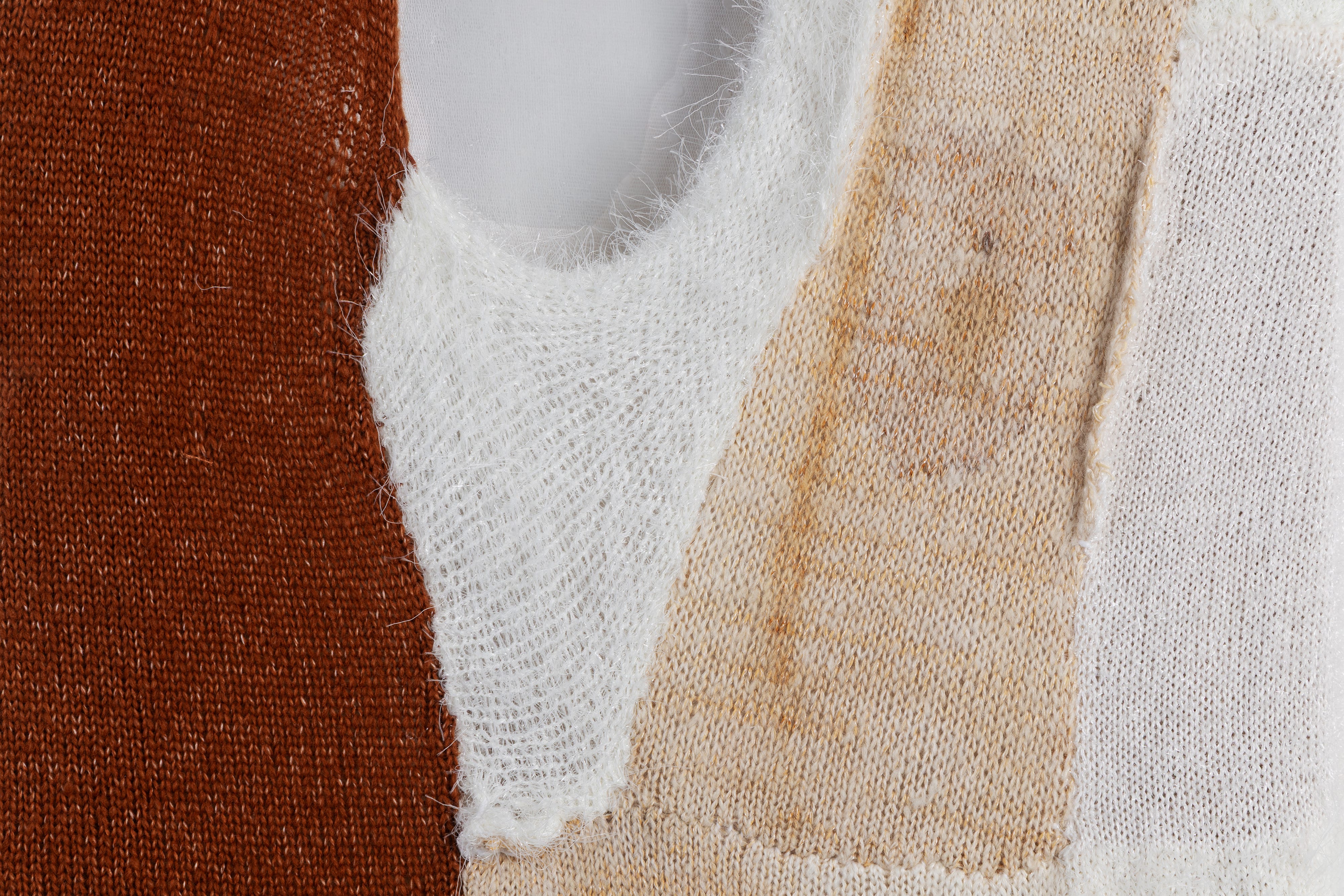
Hands-on: Time in your work is not simply something that passes - it seems to become embedded in the material itself. Do you think textiles possess a particular capacity to hold memory and duration that differs from other sculptural materials?
Seongeun Lee: Yes, I believe textile is one of the materials most capable of holding time. Unlike rigid sculptural materials, textile continuously responds to touch, gravity, tension, and use, allowing time to become visible through its physical transformation. Textile retains the movements of my hands, tension, weight, and traces of use. Every stitch carries the time of making, while stretching, folding, and deformation become physical records of time.
During this residency, another layer of time was added through oxidation. Rust was not simply a surface treatment. Instead, it became a process through which time and the environment became embedded within the textile itself. For this reason, I do not think of textile simply as a material that represents time. I see it as a medium that physically stores it.
Hands-on: You conclude by asking what remains after time has passed, framing the answer not in terms of loss but of accumulation and becoming. Looking back at this residency, what do you feel has accumulated within your own practice? What traces - material, conceptual, or personal - will you carry into your future work?
Seongeun Lee: This residency changed the way I understand relationships. Previously, I focused on relationships between people and space. I came to see that materials, environment, climate, and time are also active collaborators in the making of an artwork.
Working with rust dyeing, I became less interested in producing predetermined results and more interested in observing the transformations the material revealed. Rather than controlling the outcome, I learned to trust those changes. Living and working in an unfamiliar environment also became part of the work. It reminded me that an artwork is shaped not only by the artist, but also by place, people, time, and environment.
What remains from this residency is not simply a series of artworks, but a shift in the way I think about making. Moving forward, I hope to continue exploring the relationship between materials, time, and human existence.
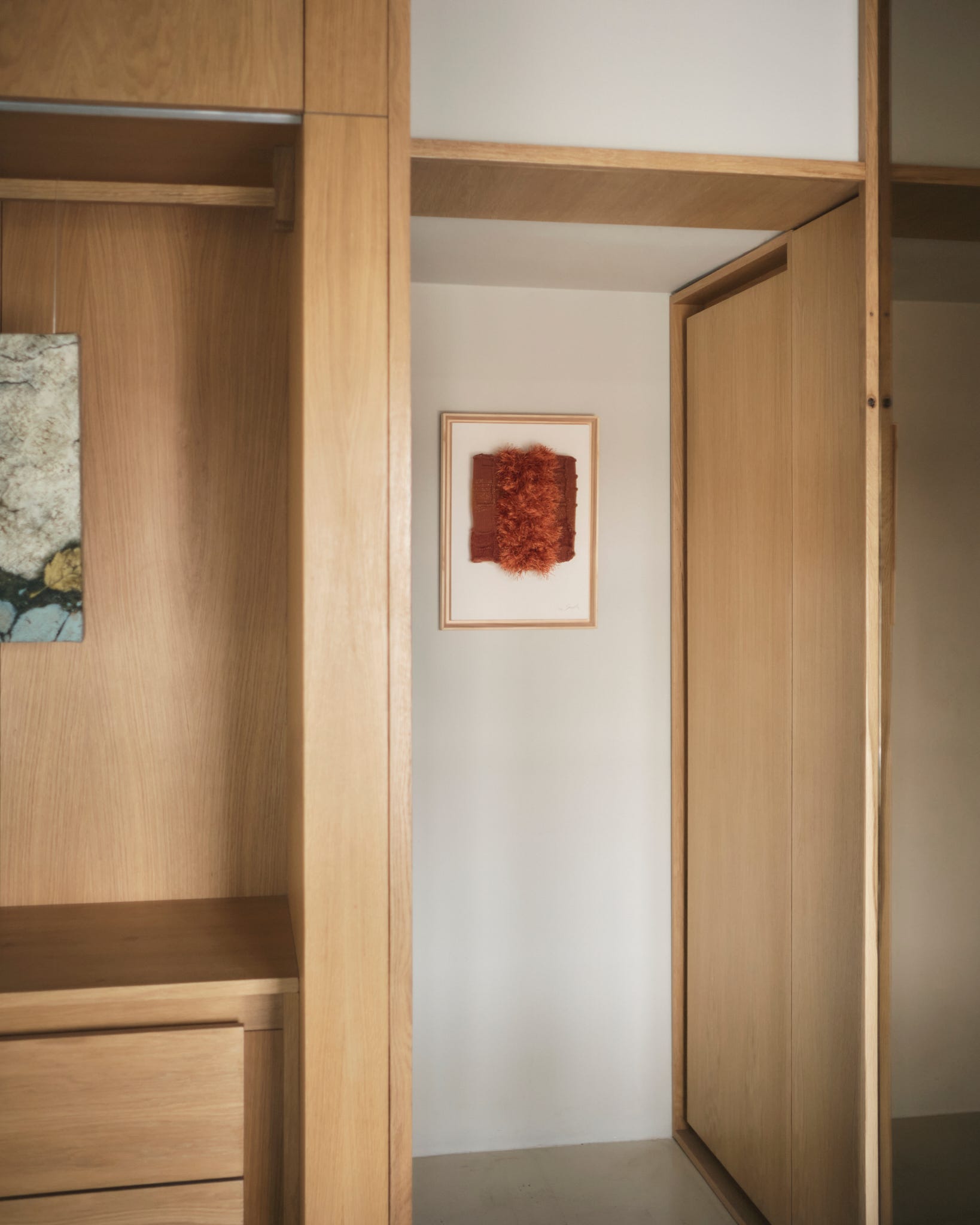
Seongeun Lee is a textile artist and researcher based between London and Busan, South Korea. She holds a PhD from Pusan National University and an MA in Textiles from the Royal College of Art in London (2024), as well as both an MA and BA in Textiles and Metal Art from Pusan National University. Her research-driven practice explores the relationship between textile, sculpture, and architectural space through material experimentation and spatial investigation.
Working primarily with soft sculpture, Lee approaches textile as an extended sculptural medium. Through modular knitted forms and accumulative structures, she explores how individual units assemble into adaptive spatial configurations shaped by gravity, tension, and movement. Her installations often unfold across ceilings, floors, and surrounding surfaces, inviting viewers to experience shifting perspectives and spatial relationships through the softness and flexibility of textile.
Lee has presented solo exhibitions including Arrangement at PNU Arts Center in Busan (2025), Connection at Hansae Gallery (2022), and Eternal Web at PNU Arts Center (2020). Her work has been exhibited internationally at venues including the Royal College of Art and Saatchi Gallery in London, Carrousel du Louvre in Paris, Bunka Gakuen Costume Museum in Tokyo, and Three Shadows Photography Art Centre in Beijing. In 2025, she received the International Prize Artist of the Year from the Effetto Arte Foundation in Florence.